

Separate Loose Undercoat from Hair You May Be Breaking
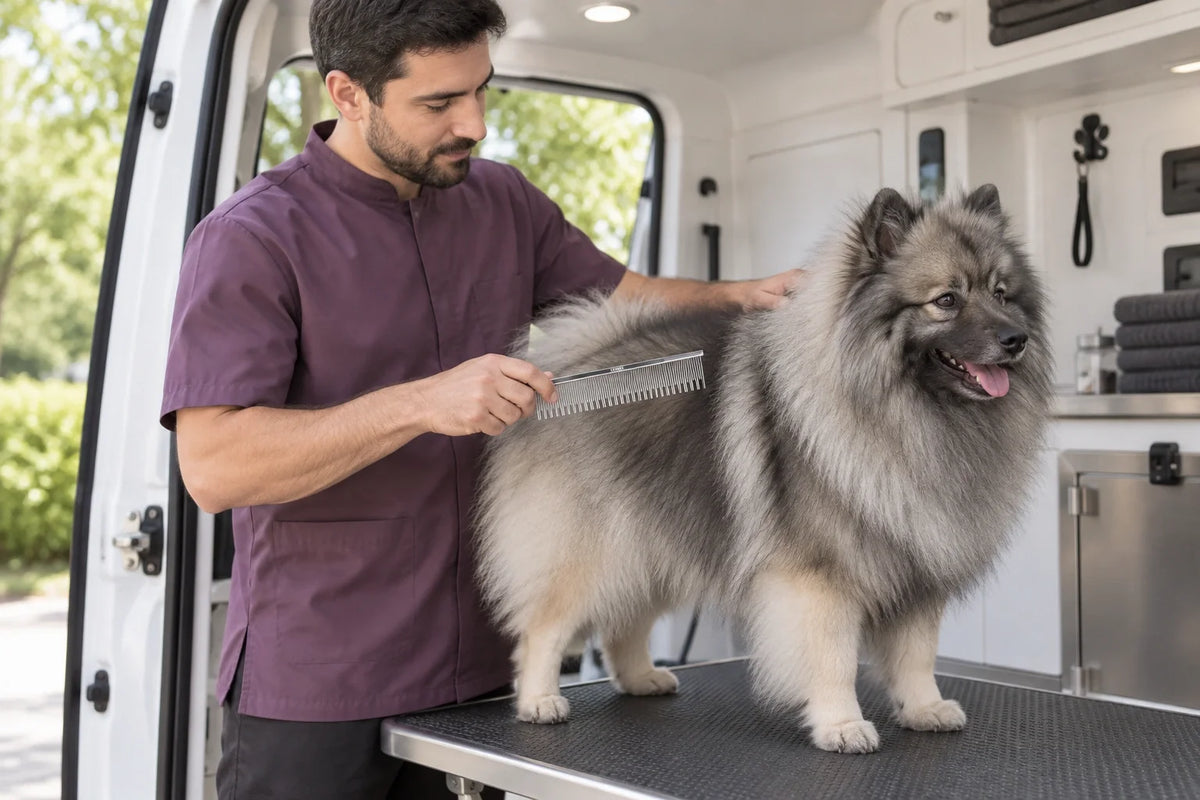
A large pile of hair is a satisfying photograph. It is a poor measure of a successful undercoat session. The more useful questions are what came out, how the remaining coat behaves and whether the dog stayed comfortable.
Most experienced groomers recognise ordinary loose undercoat. The difficult cases are the ones where the material changes during the session, the topcoat starts to look disrupted, or a familiar dog develops a new patch of short, uneven hair.
Look at the coat before looking at the pile
Note existing short patches, uneven density and areas the client reports licking or scratching. Compare the same regions with previous records where available. If you only inspect after grooming, it becomes harder to separate what was present on arrival from what changed during the appointment.
Keep the observation specific: “short hairs on the left shoulder before bathing” is useful. “Damaged coat” assigns an explanation you may not have established.
Broken hair does not identify its own cause
A published case series described six German shepherd dogs with patches of broken hair and a microscopic abnormality within the hair shaft. The dogs were otherwise well, and the cause was not established. Diagnosis depended on examination of the hairs, not the appearance of a pile on a grooming table. This unusual series is a reminder that breakage is not automatically proof of poor grooming or simple seasonal shedding. Read the original report.
Do not try to diagnose that condition in the salon. Unexpected patchy loss, skin changes, discomfort or repeated unexplained breakage deserves veterinary assessment. You can provide the location, timing and photographs with the client's agreement; the clinical interpretation belongs to their vet.
Use the material as a prompt to reassess
On routine, appropriate coat work, occasionally look at a small loose sample already removed. A change towards short fragments or a mixture that looks different from the earlier passes should prompt a pause. It does not establish the mechanism by itself.
Natural coat variation, previous clipping and different hair types can all complicate a visual comparison. Do not pluck more hair, pull on the coat or repeatedly work a patch to prove a theory. Ask the vet how they would like any samples handled if an examination is needed.
Change one practical factor before repeating the task
| Observation | Useful next decision |
|---|---|
| The comb starts meeting more resistance | Stop, reassess section size and preparation; do not add force |
| Very little loose material remains | Check whether the area's purpose has been achieved before another pass |
| The remaining surface looks disrupted | Pause the technique and review the coat with an experienced colleague |
| New discomfort or a skin change appears | Stop work there and decide the appropriate veterinary follow-up |
These are working decisions, not a diagnostic test. The aim is to notice a change early enough to respond.
Choose access and spacing, not “more leverage”
The VUNRO 6-inch Silver Double Skip Pin Comb has alternating pin lengths for suitable coat work. Its pattern does not make every resistant section safe to comb. Keep the section manageable and the grip controlled.
A compact coarse/fine comb can serve a different checking role. For a larger accessible furnishing, the 9.5-inch Lux Coarse and Fine Comb offers a longer working span. Choose that span for access and coverage, never to pull harder through resistance.
The right combination gives you distinct options. It should not encourage an endless sequence of increasingly fine passes on a coat that has already had enough.
Finish with an observation the client can use
Explain where loose coat was removed, where work was limited and what needs monitoring. If there was an unusual patch on arrival, record that calmly rather than presenting a guess about its cause.
For repeat appointments, use the same locations and similar lighting. Our guide to coat-condition notes gives a practical format. A useful record is a better outcome than the largest possible pile of hair.
Source
Tieghi and colleagues, Medullary trichomalacia in 6 German shepherd dogs, Canadian Veterinary Journal, 2003. This small case series is included to explain a limit of visual interpretation, not to suggest the condition is common or to provide a salon diagnostic method.
Keep learning
More from the Blade Blog

A Polished Coat Can Hide Fibre Damage
Read the guide →
Make Coat-Condition Notes the Next Groomer Can Use
Read the guide →


