Coat Humidity Is Not the Same as Room Humidity
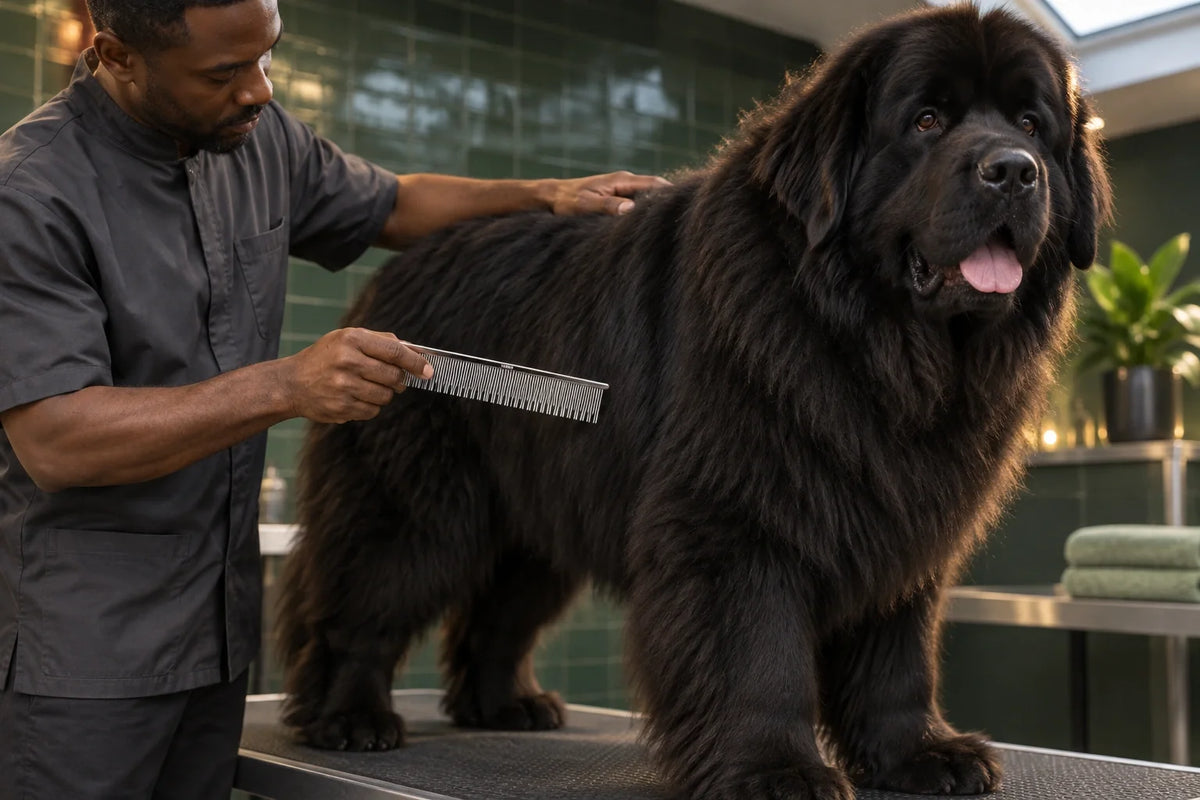
The back feels dry. The dog is ready for the finishing stage. Then the comb reaches the ventral neck and the coat feels quite different. It is tempting to treat this as an inconsistent drying technique, but a dog's coat does not have one uniform environment.
A small piece of research on Newfoundland coats makes that point unusually clearly—and gives experienced groomers a better reason to check by region.
The air inside the coat can differ from the room
Chesney's study examined 21 Newfoundland dogs in an environment maintained at 40% relative humidity. A narrow probe sampled air within the coat. Readings around the rump, middle of the lateral thigh and chest wall were about 50%; beneath the tail and on the ventral neck, they were about 70%. The coat therefore contained different local microclimates despite the shared room conditions. Read the study abstract.
Those figures are not drying targets. They are measurements of air humidity in that particular group and environment, not a test establishing how wet a freshly bathed coat may safely remain. They also cannot be applied unchanged to every breed, haircut or salon.
Do not turn a room reading into a coat verdict
A room hygrometer answers a question about the surrounding air. Your finishing decision concerns several specific areas of a particular dog. Keep those two uses separate.
Even without specialist instruments, you can improve consistency by agreeing a regional check with your team. The point is to stop the easiest-to-reach area becoming the proxy for the whole coat.
- Use a consistent sequence. Revisit the neck, chest, body, leg furnishings and tail area before moving to finishing. Adjust the sequence to the dog and the areas actually bathed.
- Check access, not just the outer appearance. On comfortable, intact coat, lift a small section gently enough to see and feel its condition without dragging on the skin.
- Record the area that needs more work. “Neck still damp” is more useful than “dog needs another ten minutes”. It tells the next person where to look.
- Recheck after repositioning. An area hidden while the dog sits may become accessible in a different comfortable position. Do not force a posture simply to complete the checklist.
Separate preparation from finishing
If you start shaping while some sections remain noticeably different from others, it becomes harder to tell whether the next uneven patch comes from your cutting technique or from inconsistent preparation. Stop and resolve the preparation issue before changing tools or taking the coat shorter.
A useful handover has two parts: which areas have been checked, and which still need attention. Keep “looks fluffy” out of the pass criterion. A visually lifted outer coat can encourage a premature decision when the task is to assess the whole working section.
For a dog that is becoming tired or worried, the response is not automatically more heat or a longer uninterrupted session. Pause, reassess comfort and choose a manageable plan. Follow the dryer manufacturer's instructions and supervise drying throughout. The humidity study does not justify a temperature setting or an exposure time.
Put the comb to work as an assessment tool
The comb is useful here because it lets you work through a small section deliberately. It is not a moisture meter. If the coat is resistant, avoid pulling the tool through to prove a point; work out whether you are dealing with remaining tangles, dense loose coat or a section that needs a different approach.
The VUNRO 6-inch Double Skip Pin Comb and 5-inch Coarse and Fine Straight Comb give you different options for section access and checking. Choose according to the coat and the space you need to reach. Neither is permission to force through a mat, and neither replaces a comfortable drying routine.
A larger salon may find it useful to keep separate, properly cleaned tools ready for preparation and final checking. A smaller salon may prefer one suitable comb and a clear cleaning sequence. The useful purchase is the one that makes your actual process easier to follow.
Try a small process review
Over your next suitable appointments, note the last area to be ready for finishing. Do not add drying time or experimental handling for the sake of collecting data. Simply record what you already observe.
Then look for a practical pattern. Are handovers omitting the same area? Does a certain coat type need a different sequence? Is a dog repeatedly asked to hold an uncomfortable position? Change one part of the process and see whether the handover becomes clearer.
You are looking for fewer uncertain decisions, not a universal “dry in X minutes” rule. For the wider preparation sequence, read how to prepare the coat before clipping.
Source and scope
Chesney C.J. Mapping the canine skin: a study of coat relative humidity in Newfoundland dogs. Veterinary Dermatology, 1996;7(1):35–41. Abstract and citation. DOI: 10.1111/j.1365-3164.1996.tb00224.x.
This is a small, breed-specific study of coat microclimate. The regional salon check proposed here is an application of its central observation, not a validated test of dryness or a clinical skin assessment.
Keep learning
More from the Blade Blog

A Polished Coat Can Hide Fibre Damage
Read the guide →
Separate Loose Undercoat from Hair You May Be Breaking
Read the guide →