Learn Scissor Control on Practice Fur First
Lesson 11 of 12 · Grooming for pet parents
Learn scissor control on practice fur before bringing scissors near a moving dog. The first skill is making one small, intentional cut and checking what changed, rather than repeatedly snipping until an edge looks short enough.
Keep this first exercise off the dog
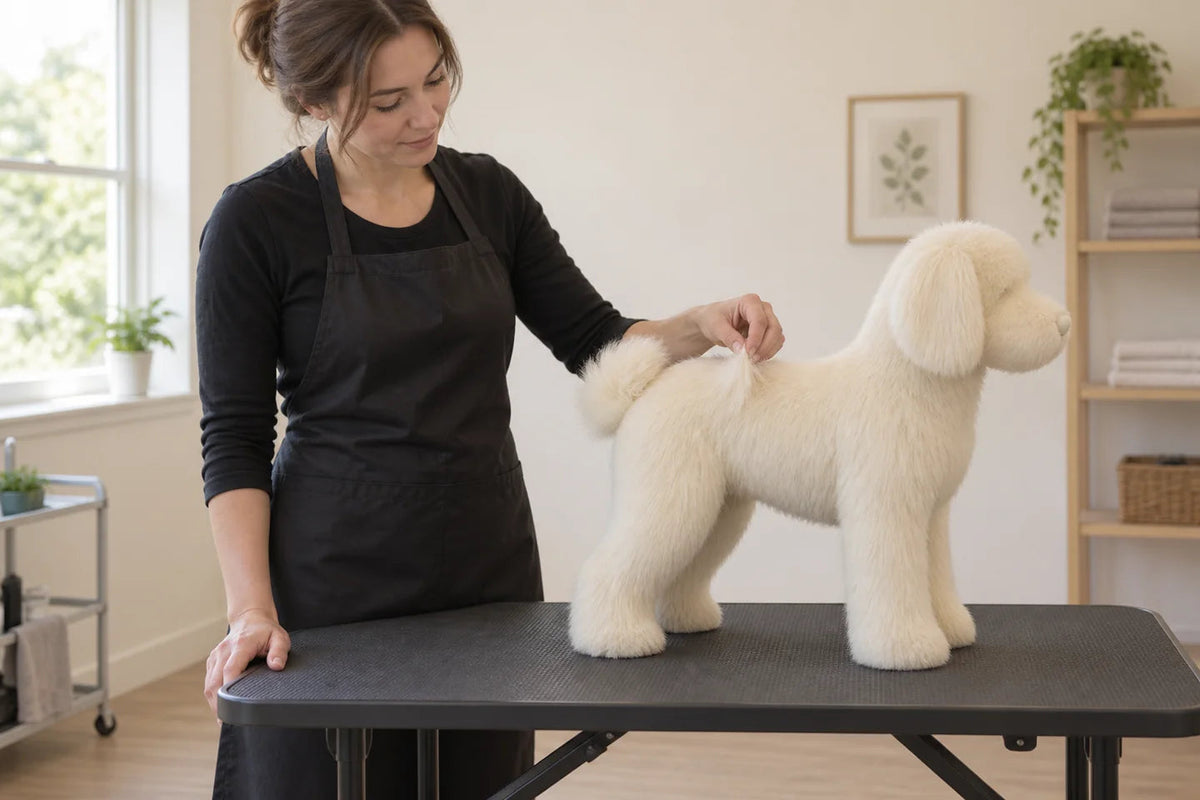
Set up a stable, well-lit bench with a secured practice-fur sample or grooming mannequin. Keep the work clear of your lap, loose clothing and fingers. Use a sample with enough free hair above its backing to see what you intend to remove. The backing is not dog skin and does not teach you how real folds or movement behave.
The course uses one pair: the VUNRO 7.5-inch Precision Curved Scissors in 440C steel. Begin with control of that tool instead of changing among several types. Check its condition and follow the supplied care instructions. If operation feels damaged or abnormal, do not force it or attempt an improvised adjustment.
Practise moving before cutting
With the scissors closed, identify how the curve lies against the intended outline. Practise picking up, positioning and putting down the tool safely. Keep the closed tips directed away from yourself and others. Open only when the intended free edge is clearly visible and your supporting hand is outside the blade path.
A groomer can demonstrate a comfortable grip and controlled opening movement. If you find yourself using your whole arm to chase the line, make the task smaller and practise again. Avoid treating long blades as permission to remove a large piece in one cut.
Try the comb, cut, inspect sequence
- Comb a small area of the practice fur into its natural fall.
- Choose only a few projecting tips that you can see clearly above the intended outline.
- Position the curve as demonstrated and make one small, controlled cut.
- Close and move the scissors away before using the comb again.
- Recomb, step back and inspect. Make another cut only if there is a clear reason.
Keep the comb and scissors as separate movements while learning. Chasing an edge while both hands move at once makes it harder to see the cutting line. Do not slide scissors along a comb and assume the comb would protect skin on a real dog.
Learn what overworking looks like
On the practice sample, mark your intended outline on a separate drawing or reference photograph. Compare after a few small cuts. It is easy to keep “correcting” until the whole shape becomes shorter than planned. Stop and review before that happens.
If the fur moves away rather than cutting as expected, check your preparation, position and tool condition. Do not compensate by gripping harder or closing repeatedly over the same clump. Practising observation is as important as practising the cutting movement.
Know what this lesson does not qualify you to do
Before working on a live dog, get practical instruction for the specific area and demonstrate that you can maintain a clear view and respond safely to movement. Face, eyes, ear edges, genital areas, skin folds and mat removal are not beginner scissor exercises. Never cut into a knot or beneath a mat because the skin appears to be farther away.
Even a comb between the blade and the dog is not a guarantee against catching skin. A dog can move faster than you can close the scissors. Put the tool away if the dog cannot remain comfortable with the required handling; the right finish can be completed professionally.
Your practice checkpoint
Photograph the practice sample before and after, using the same angle. Note whether you removed only the intended tips and whether you could stop after each cut. Repeat on practice fur until the movements feel deliberate, then ask a groomer what is appropriate to transfer to your own dog's routine.
For tool-selection context, read our scissors and combs guide. Buying another type of scissors is not a substitute for learning control with the first pair.
Evidence and further reading
Keep learning
More from the Blade Blog
Start Grooming at Home: Your Dog Comes First
Read the guide →
Meet Your VUNRO Tools: Choose the Right Grooming Setup
Read the guide →